



The Minnesota State Energy Center of Excellence, in collaboration with Xcel Energy, recently concluded a three-part continuing education program, "Energy Education for Educators," for Minnesota K-12 teachers. The program began with a mandatory table-setting 90-minute webinar with Xcel staff, following which each participant had the opportunity to tour one of Xcel's two nuclear plants (Monticello or Prairie Island). The experience offered our thirty-four participating educators with a sharp perspective on commercial nuclear generation, electrical grid reliability, and rewarding workforce pathways.
Xcel Energy's presentation slides, the Energy Center's educational pathways slides, and a full recording of the introductory webinar are all available online. The webinar covered the following core topics:
- Grid Dynamics and Baseload Generation: The role of firm, dispatchable nuclear generation in stabilizing regional transmission networks, with specific focus on capacity factors exceeding 90 percent relative to intermittent sources.
- Nuclear Power Plant Engineering Basics: The basics of nuclear energy, including the atom, fission, and the difference between the Boiling Water Reactor design at Monticello and the Pressurized Water Reactor architecture used at Prairie Island.
- Radiological Safety, Waste Management, and Safety: The realities of of ionizing radiation (including exposures in everyday life), the use of water and hardened-cask spent fuel storage, and nuclear power plant safety records.
- Workforce Entry Points and Technical Qualifications: Detailed discussions of the educational requirements of nuclear power careers, including standardized Edison Electric Institute (EEI) aptitude testing, on-site training by Xcel, plant operations licensing under the Nuclear Regulatory Commission, and accredited collegiate engineering disciplines.
Nuclear Facility Career Pathways and Workforce Profiles
A central focus of the instructional session was detailing the primary occupational categories required to operate and maintain commercial nuclear facilities, along with their specific hiring standards and educational prerequisites:
- Plant Operations (Non-Licensed Operators, Reactor Operators, and Senior Reactor Operators): Operations personnel manage the active distribution of electrical output and direct the control room instrumentation of the reactor and turbine systems. Entry into operations does not require a four-year degree and begins with starting salaries around $70,000, with senior personnel earning salaries of upwards of $250,000. Candidates must pass the EEI Plant Operator Selection System (POSS) examination, undergo rigorous medical evaluations, and complete up to twenty-four months of site-specific training. Licensing as a Reactor Operator (RO) or Senior Reactor Operator (SRO) is granted directly by the federal Nuclear Regulatory Commission and is non-transferable across different nuclear stations without completing extensive re-qualification.
- Skilled Maintenance Trades (Mechanics, Electricians, and Instrumentation & Control Technicians): Represented by the International Brotherhood of Electrical Workers (IBEW), these positions maintain the physical integrity of plant hardware under formal apprenticeship models. Mechanics oversee rotating components, pumps, and heavy rigging. Electricians service electrical distribution systems. Instrumentation and Control (I&C) technicians calibrate low-voltage digital and pneumatic instrumentation, ensuring regulatory precision across all plant sensors and safety systems. These positions also must pass an EEI test, the Power Plant Maintenance Positions Select System (MASS) exam.
- Facility Engineering Disciplines: Nuclear power plants primarily employ many mechanical and electrical engineers, alongside smaller numbers of nuclear, civil, chemical, and environmental engineers. A primary hiring standard emphasized during the briefing was graduation from an ABET-accredited engineering curriculum.
- Radiation Protection (Health Physics): Radiation Protection (RP) technicians function as industrial health officers, actively surveying radiologically controlled areas, determining personnel exposure boundaries, overseeing electronic dosimeter monitoring, and establishing contamination barrier protocols.
- Plant Chemistry and Environmental Monitors: Chemistry technicians collect and evaluate water samples. Maintaining strict water chemistry is essential to plant operations. Protecting groundwater, rivers, and habitats adjacent to the stations is also non-negotiable. "The environment should not see that we have a nuclear reactor here."
- Planners and Schedulers: Planners and schedulers write instructions, coordinate work windows during active generation, and schedule component surveillance tests.
- Supply Chain: These personnel source nuclear-grade and safety-related components, manage inventory, and audit vendors to ensure replacement valves, instrumentation, and consumables adhere to federal quality-assurance standards.
- Technical Instruction and Operations Training: Training departments prepare candidates for regulatory licensing and facilitate continuous training cycles for active crews, who rotate into full-scale control room simulators every six weeks. Instructors use the performance-based Systematic Approach to Training (SAT).
- Plant Helpers: These workers serve in the foundational entry-level union classification. They perform general facility upkeep, materials handling, and operational support. The job requires a high school diploma and offers a competitive hourly wage, comprehensive benefits, and internal bidding seniority for advancement into licensed operations or maintenance apprenticeship pipelines. The Senior Reactor Operator our tour met at Prairie Island began his career as a Plant Helper!
Following the instructional session, educators participated in guided technical site visits at both the Prairie Island Nuclear Generating Station in Welch and the Monticello Nuclear Generating Station. The tours included river water intake pumps and valves, safety equipment, massive electrical generation turbines, control rooms, backup generators, waste storage, and much more.
The Energy Center extends sincere thanks to the gracious Xcel Energy personnel who spent their time and energy making these site visits possible:
- Monticello Nuclear Generating Station: Julie Weber (Control Room Supervisor), Judy Gutridge (Operations Training Instructor), and their colleagues.
- Prairie Island Nuclear Generating Station: Kamini Balakrishnan (Program Engineer), Harrison Bourgoin (Program Engineer), Bobbi Jo Halvorson (Fleet Nuclear Oversight), Ashley Malek (Equipment Reliability Director), Anne Velasco (Senior Engineer), and their colleagues.
The program benefited from the active participation of educators representing public school districts, charter schools, and higher education institutions from across Minnesota:
- Anoka-Hennepin School District (Andover High School and Anoka High School)
- Becker Public Schools (Becker High School)
- Community School of Excellence
- Creekstone Montessori School
- Dassel-Cokato Schools (Dassel-Cokato High School)
- Edina Public Schools
- Jordan Public Schools (Jordan High School)
- Metropolitan State University
- Minneapolis Public Schools (Thomas Edison High School and Wellstone International High School)
- Minnesota Transitions Charter School (Minnesota Excellence in Learning Academy / MEC)
- Monticello Public Schools (District 882 / Monticello Middle School)
- Northfield Public Schools
- Osseo Area Schools (ISD 279 / Osseo Senior High School)
- Red Wing Public Schools
- River Bluff Education Center
- Robbinsdale Area Schools (Robbinsdale Armstrong High School)
- Saint Paul Public Schools (Gordon Parks High School)
- St. Cloud Area School District
- Tri-City United Schools
- West St. Paul-Mendota Heights-Eagan Area Schools (ISD 197 / Two Rivers High School)
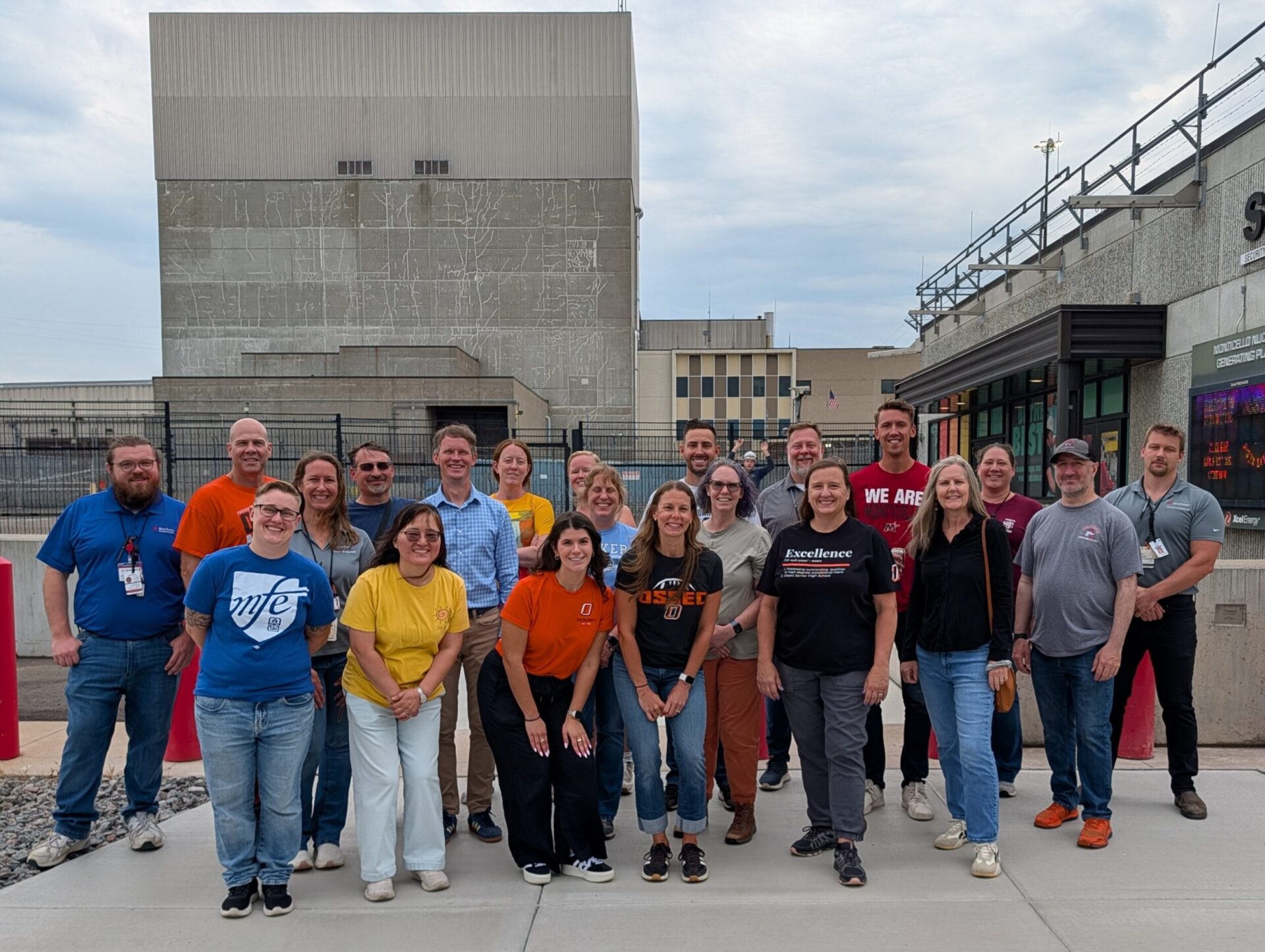
Photographs: Educator cohorts on-site during technical walkthroughs at the Monticello and Prairie Island Generating Stations.