



Median Annual wage
$104,400

Entry-Level Training Required
High School or Equivalent

Median Hourly wage
$50.19
5-Year Growth Projection
+9% in Minnesota
What is a powerline worker?
Powerline workers are skilled professionals who keep communities powered and connected. They install, inspect, and maintain the electrical lines that deliver energy to homes, businesses, and critical services. With strong technical knowledge, they work to quickly repair outages and ensure systems operate safely and reliably. Powerline workers get the job done whenever and wherever it's necessary, day or night, rain or shine.
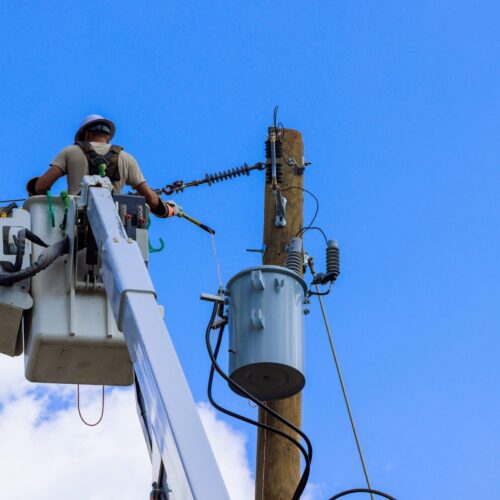
A powerline worker’s day starts early, usually before sunrise, with a quick check of the weather because it can shape everything that follows. After arriving at their workplace, the crew gathers for a safety briefing to review the day’s tasks and potential hazards, then loads trucks with tools, cables, and protective gear. Much of the day is spent climbing poles or working from bucket trucks, repairing or installing power lines and transformers while following strict safety procedures and staying in constant communication with the team.
Since outages demand immediate attention, work continues through heat, cold, wind, or rain, requiring intense focus and physical endurance because even small mistakes can be dangerous. When storms hit, the day can stretch late into the night as crews respond to emergencies to restore power. By the time the worker heads home, there is a strong sense of pride knowing their work keeps communities running and lights turned on.
The job of a powerline worker is perfect for those who don’t mind a little risk in their career and thrive on excitement. There is always a new challenge to conquer as a lineworker, which provides a strong sense of duty and satisfaction. Powerline workers often value teamwork and camaraderie because the job depends on trust and clear communication with the crew. The career also provides solid pay, good benefits, and long-term stability, especially as demand for reliable electricity continues to grow. If you like to be challenged and want to provide for communities, a career as a powerline worker may be for you.
Follow and enforce safety procedures by inspecting equipment, de‑energizing systems, applying grounding, and securing work areas before beginning any task.
Install, maintain, and repair electrical transmission and distribution systems, including power lines, poles, transformers, meters, and related equipment.
Access and work on elevated or hard‑to‑reach equipment by climbing poles and towers or operating bucket trucks and lifting equipment.
Test, inspect, and troubleshoot power lines and electrical components using diagnostic tools to identify faults, damage, or safety hazards.
Prepare and maintain job sites, including transporting tools and materials, digging trenches or holes, clearing vegetation, and coordinating work with crew members.
To get started as a powerline worker in Minnesota, you will want to get a major head start by earning a powerline technology diploma or degree at a Minnesota State technical college, while also securing your Class A Commercial Driver’s License (CDL) to operate heavy utility equipment. From there, you will enter a paid utility apprenticeship to accumulate the 48 months of registered, outdoor field experience required by the state. Once your hands-on training is complete, you’ll be ready to officially achieve your journeyman lineworker status through the Minnesota Department of Labor and Industry.

SELECT a college to discover the programs at Minnesota State